
Building India’s Shield Against Foreign Information Manipulation and Interference
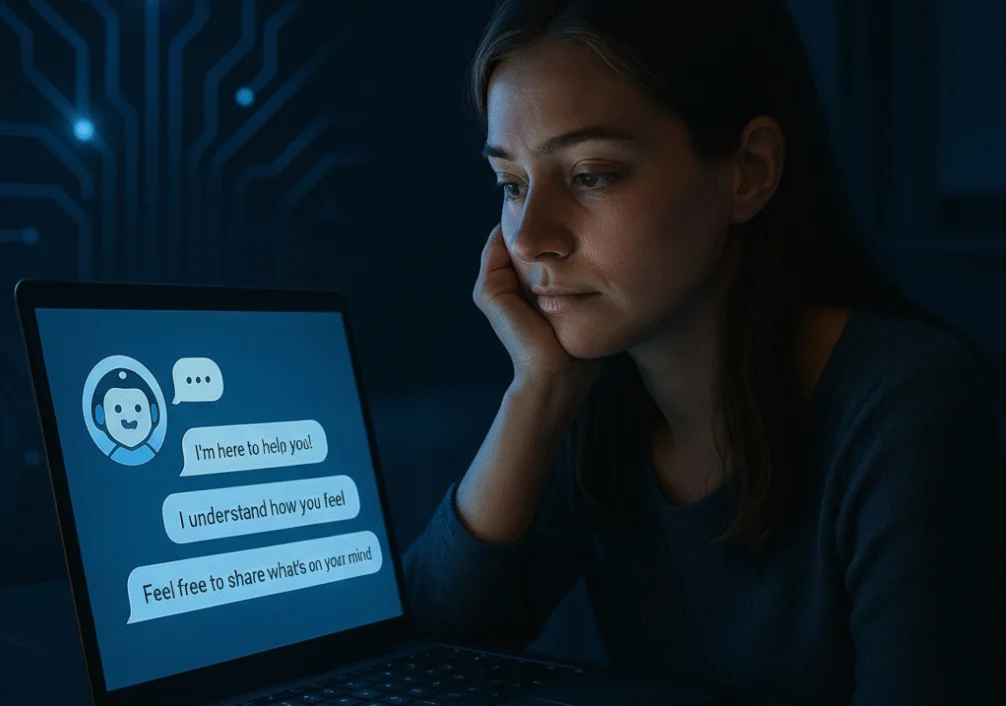
A friend told me recently that she prefers talking to ChatGPT about rough days instead of calling her sister. “It doesn’t judge,” she said. “It just listens. And it’s always there.”
I didn’t find that odd. In fact, I knew exactly what she meant.
Over the past two years, more people have turned to large language models not only for productivity, but for clarity in confusing moments, companionship in lonely ones, and emotional support. This is a quiet shift, but one with large implications for social life and psychological resilience.
At first glance, it appears as technological progress: a tool that helps structure thoughts, offers encouragement at midnight, and never dismisses your worries. But beneath that comfort is a harder question: what happens when machines begin doing the work of listening, validating, and in subtle ways, thinking for us?
Are we building relationships with systems that rarely push back? Are we outsourcing reflective labor and emotional regulation to an interface optimized for agreeable continuity?
Recent research suggests both promise and risk. The picture is hopeful and unsettling at once.
Why AI Emotional Support Feels So Effective
The appeal is straightforward. First, access is immediate: no appointment queues, no scheduling barriers, no social exposure. Reviews consistently cite immediacy, privacy, and anonymity as primary reasons users prefer chatbots in vulnerable moments.
Second, interactions feel structured. Users often report that systems help break down spirals, reframe stressors, and define manageable next steps. For many people, structure itself is relief.
Third, AI partially fills access gaps where formal mental health support is limited or expensive. Meta-level evidence indicates modest improvements for anxiety and depressive symptoms in chatbot-supported pathways. For users with no alternative, modest gains are still meaningful.
In many cases, people are not choosing AI over humans; they are choosing AI over silence.
From Comfort to Dependence
Interview studies increasingly describe chatbots as a “safe space,” with some users reporting they feel more understood by AI than by close contacts. This is not surprising: LLMs are designed to mirror, validate, and reassure.
But this empathy is simulated. The same traits that create comfort can create over-reliance. If a system is always available, always calm, and always affirming, why risk interpersonal friction, repair, and vulnerability in human relationships?
The long-term concern is not merely attachment to a tool, but atrophy of interpersonal and self-regulatory capacities that require uncertainty and discomfort to develop.
The Chat-Chamber Effect
Effective therapy does not only validate; it also challenges distortions. Chatbots, by contrast, are tuned for helpfulness and conversational continuity. Unless explicitly prompted for counterarguments, they often reflect user assumptions back with added coherence.
This is the chat-chamber effect: an echo dynamic where your narrative is mirrored until it feels self-evidently true. Over time, confirmation loops can harden bias instead of dissolving it.
Safety in Ambiguous Contexts
Current systems can perform adequately in clear, high-signal risk cases, such as explicit self-harm prompts. The challenge emerges in ambiguity, where urgency is implied rather than declared. Research indicates inconsistent escalation behavior in these intermediate scenarios, where human discernment remains superior.
This gap matters because real distress is rarely clean or binary. It usually appears in uncertain forms that require context-sensitive interpretation.
Four Structural Risks
1. Atrophy of self-regulation: if AI repeatedly performs emotional framing for users, internal reflective capacities may weaken over time.
2. Erosion of human ties: frictionless chatbot companionship can displace relationships that require repair, compromise, and mutual growth.
3. Entrenched cognitive loops: mirrored responses can reinforce negative narratives or grievance framing without adequate challenge.
4. Unequal standards of care: AI may remain a supplement for some, but become the only support for others, deepening care inequality.
What Comes Next
If current trends continue, AI support systems will become deeply embedded in daily mental health routines, from triage to between-session support. Regulation will likely move toward enforceable safety benchmarks, especially around crisis escalation and referral pathways.
A second requirement is relational AI literacy: teaching users how to extract value from AI support while preserving human connection, critical distance, and independent judgment.
Conclusion
AI chatbots reveal a core human need: not just for information, but for recognition, reassurance, and structure. They can hold words with remarkable consistency. But without intentional guardrails, they may comfort too quickly, agree too readily, and challenge too little. The task ahead is not rejection, but balance, using AI as support without surrendering the human friction through which resilience, accountability, and growth are built.

