
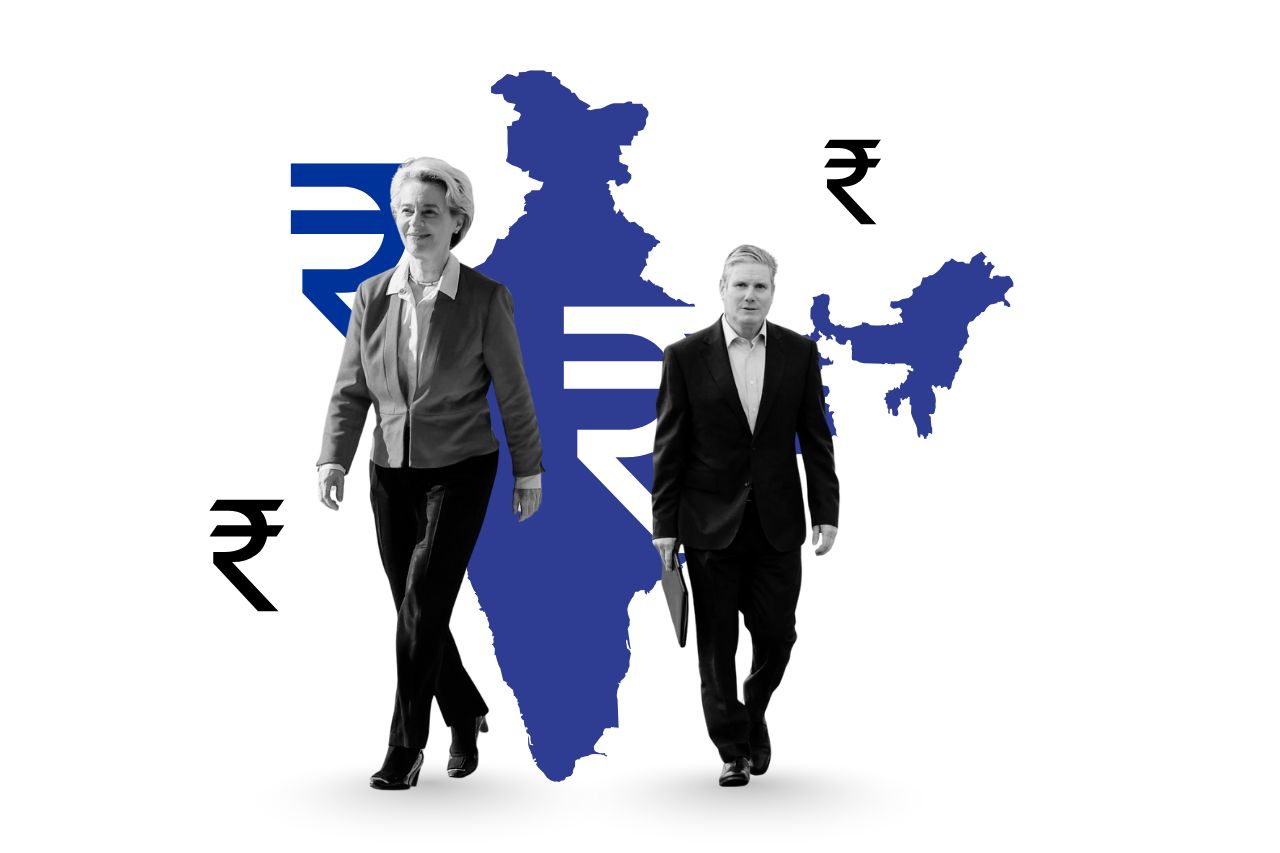
India’s trade relationships with the United Kingdom and the European Union are at a turning point, driven by a shared vision to harness technology, artificial intelligence (AI), and innovation in a rapidly shifting global landscape. As the world’s fifth-largest economy, India is leveraging its tech expertise and young workforce to deepen ties with these Western partners.
The recently signed UK-India Free Trade Agreement (FTA) and ongoing EU-India FTA talks signal a new era of collaboration, where digital trade and AI are as critical as traditional goods. Drawing from books like India and the European Union in a Turbulent World by Rajendra K. Jain, which explores post-Cold War dynamics, and insights, this article examines how these trade deals are reshaping global opportunities through technology and geopolitics.
UK-India FTA: A New Chapter After Brexit
The UK-India FTA, finalized in July 2025, is a landmark deal projected to boost bilateral trade by £34 billion annually by 2040. With global trade tensions rising, this agreement is a strategic move for both nations.
Bilateral trade reached £38 billion in 2024, and the FTA cuts tariffs on goods like textiles and whiskey while opening markets for services. A joint statement on October 9, 2025, launched the India-UK Connectivity and Innovation Centre, targeting AI and 6G development. The EU-India FTA, meanwhile, has seen limited progress.
With trade hitting €120 billion in 2024, the EU is India’s second-largest partner, but issues like sanitary standards and carbon taxes complicate talks. EU leaders, including Ursula von der Leyen, are pushing for a comprehensive deal covering trade and investment.
This deal reflects a strategic pivot. As India’s Policy Towards the European Union in the Post-Cold War Era by Patryk Kugiel notes, India’s move from non-alignment to partnerships counters China’s supply chain dominance. The EU’s Carbon Border Adjustment Mechanism (CBAM) aligns with India’s green tech goals but could burden exporters without concessions. A successful FTA could leverage €140 billion in existing EU investment in India, boosting sectors like semiconductors.
Technology and Digital Trade: The Heart of Modern Trade
Both FTAs emphasize digital trade, recognizing technology’s role in economic growth. The UK-India deal streamlines data flows, boosting e-commerce and fintech. India’s digital economy, set to reach $1 trillion by 2028, gains from UK expertise in cybersecurity and joint 6G projects. The EU-India Trade and Technology Council (TTC) focuses on 5G and digital standards.
These agreements shift trade toward digital assets. Lower tariffs on tech hardware could raise India’s exports while fostering R&D partnerships. The broader objective is regulatory harmony and reduced digital fragmentation.
AI and Data Regulation: Opportunities and Challenges
AI is central to these partnerships. The UK-India FTA promotes AI collaboration, including AI-enabled customs systems. The EU’s AI Act, paired with India’s work on large language models through the TTC, is shaping an ethics-led AI agenda.
Data regulation remains complex. India’s data law architecture, influenced partly by GDPR, still includes localization impulses that may collide with EU preferences on data mobility. At the same time, innovation opportunities in quantum and biotech collaboration are growing.
Geopolitics: Shaping the Bigger Picture
Geopolitics is a major driver. The UK-India FTA helps hedge global trade uncertainty, while EU-India alignment strengthens Indo-Pacific strategic calculations. Europe’s search for supply chain diversification has clearly increased India’s strategic relevance.
Global AI Trends: Powering the Future
Global AI investment reached $33.9 billion in 2025. Robotics, frontier model efficiency, and governance standards are accelerating. For India, the UK, and the EU, this creates an opening to align industrial ambition with coordinated rules and shared R&D.
In closing, these FTAs are more than trade deals. They are a strategic roadmap for collaboration in a tech-driven and geopolitically contested era. Challenges around regulatory alignment remain, but the upside, including long-term digital growth and strategic resilience, makes this partnership trajectory deeply consequential.

