Building India’s Shield Against Foreign Information Manipulation and Interference
In a race that seemed stacked against a grassroots insurgent, Zohran Mamdani managed to unite solidarity, tech-savvy organizing, and a message of hope into a triumphant campaign and win. Here’s how he did it, and why this win might just be the beginning.
Building solidarity from the ground up
Mamdani’s campaign started with a clear message of solidarity with working-class New Yorkers, renters, immigrants, and people whose voices had been sidelined. He didn’t rely solely on big money or polished photo-ops: he knocked doors, talked face-to-face, and invited participation. Studies of his campaign show that he “reshaped the electorate, bringing hundreds of thousands of non-voters out to the polls from young people to left-behind immigrant communities.” [1]
Another report says his team knocked 1.6 million doors, held more than a quarter of a million direct conversations, and engaged more than 50,000 volunteers. [2]
This was not just a campaign to people, but a campaign with people. The shared sentiment became: “we’re in this together,” and that solidarity translated into votes. Against money power, they won through repeated civic contact and neighborhood mobilization.
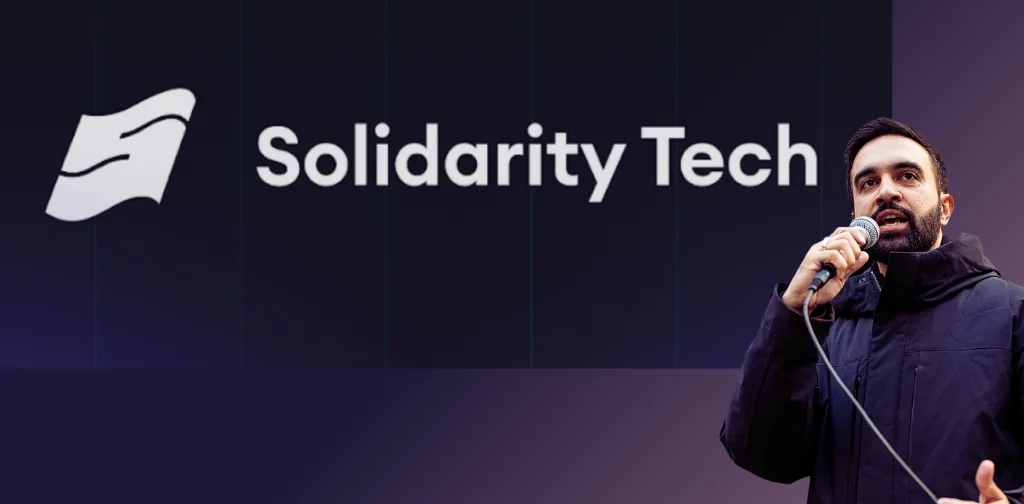
But solidarity alone was not the only tool. The campaign leaned into tech: social media storytelling, data-driven canvassing, multilingual outreach, volunteer apps, and rapid feedback loops. Solidarity Tech helped scale this volunteer wave. [3]
In effect, old-school door-knocking merged with algorithmic coordination. Volunteers got optimized lists, messages were refined, and content spread across channels in near real-time.
How Solidarity Tech works
Solidarity Tech functions as an all-in-one CRM-organizing platform for campaigns, unions, and grassroots networks. It combines calling, texting, email, event management, field applications, volunteer tracking, and donations into one workflow. [4]
Its core value is conversion. Interest captured via forms moves into targeted follow-up, then to event commitments, shift assignments, and turnout execution. It supports multilingual outreach and field segmentation, helping transform digital momentum into real, measurable organizing output.
When controversy emerged, including criticism around positions on global issues, the campaign did not abandon its base narrative. Instead, it intensified direct communication through volunteers and digital channels, bypassing traditional gatekeepers.
The result was a campaign that prevailed despite both internal and external resistance, showing how bottom-up organizing, amplified by integrated technology, can outperform conventional establishment advantages.
What comes next
Victory is not the endpoint. Governance now becomes the test: implementing promised policies amid institutional resistance, business pushback, and internal coalition stress. The same network that won votes must now evolve into an accountability and delivery infrastructure.
If that transition succeeds, this moment may indeed be the beginning, not only for one campaign, but for a broader model of elections where solidarity and digital coordination are co-equal engines of democratic power.

